

焊接機器人在自動化生產過程中的優勢
發布時間:
2023-05-05 14:35
焊接機器人作為一種先進的自動化焊接設備,其應用領域越發廣泛,進而也推動了我國焊接行業進入工業自動化時代的重要標志。如今自動化水平的不斷提升,企業對于焊接質量的要求也越來越高。
As an advanced automated welding equipment, welding robots have become increasingly widely used, which has also promoted China's welding industry to enter the era of industrial automation as an important symbol. Nowadays, with the continuous improvement of automation level, enterprises have increasingly high requirements for welding quality.
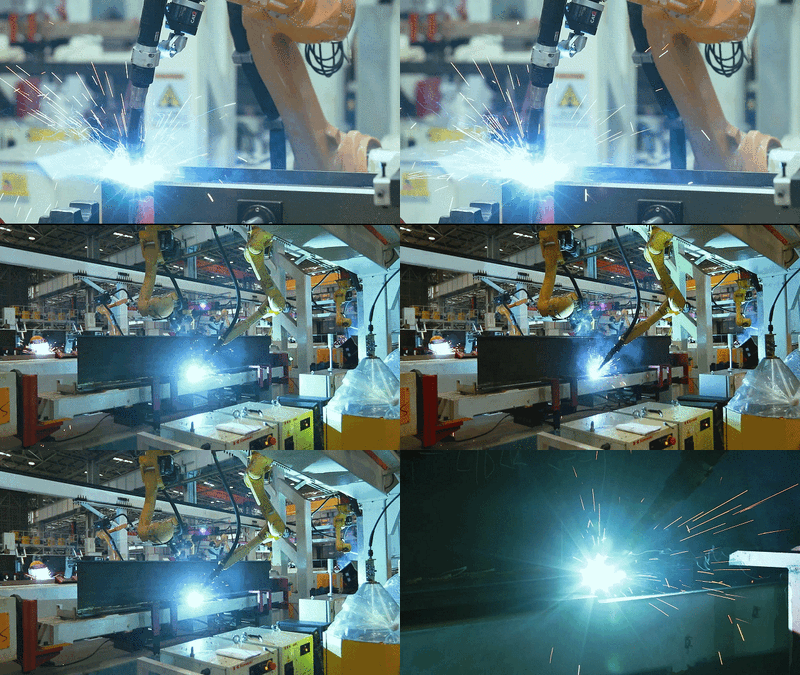
自動化生產要求減少人力,提高產品一致性,提高產品質量,更適合大批量生產,降低生產成本,提高生產效率。而人工焊接時,由于受到技術水平、疲勞程度、責任心、生理極限等客觀和主觀因素的應影響,難以較長時間保持焊接工作的穩定性和一致性。
Automated production requires reducing manpower, improving product consistency, improving product quality, making it more suitable for mass production, reducing production costs, and improving production efficiency. However, during manual welding, it is difficult to maintain the stability and consistency of welding work for a long time due to objective and subjective factors such as technical level, fatigue level, sense of responsibility, and physiological limits.
由于焊接惡劣的工作條件,愿意從事手工焊接的人在減少,熟練的技術工人更有短缺的趨勢。可以說,焊接機器人很大程度上滿足了焊接自動化的要求,自動化生產方面的優勢可以總結為以下幾條:
Due to the harsh working conditions of welding, the number of people willing to engage in manual welding is decreasing, and there is a trend of a shortage of skilled technical workers. It can be said that welding robots largely meet the requirements of welding automation, and the advantages of automated production can be summarized as follows:
1、穩定和提高焊接質量,保證其均一性。
Stabilize and improve welding quality, ensuring its uniformity.
采用機器人焊接時,每條焊縫的焊接參數都是恒定的,焊縫質量受人為因素影響較小,降低了對工人操作技術的要求,因此焊接質量穩定。而人工焊接時,焊接速度、干伸長量等都是變化的,很難做到質量的均一性。
When using robot welding, the welding parameters of each weld seam are constant, and the quality of the weld seam is less affected by human factors, reducing the requirements for workers' operating skills, thus ensuring stable welding quality. During manual welding, the welding speed, dry elongation, and other factors are variable, making it difficult to achieve uniformity of quality.
2、改善了勞動條件。
Improved working conditions.
采用機器人焊接,工人只需要裝卸工件,遠離了焊接弧光、炯霧和飛濺等。對于點焊來說,工人無需搬運笨重的手工焊鉗,使工人從高強度的體力勞動中解脫出來。
Using robot welding, workers only need to load and unload workpieces, away from welding arc light, sharp fog, and splashes. For spot welding, workers do not need to carry bulky manual welding tongs, freeing them from high-intensity physical labor.
3、提高勞動生產率。
Improve labor productivity.
機器人可以24小時連續生產。隨著高速高效焊接技術的應用,采用機器人焊接,效率提高得更為明顯。
Robots can produce continuously 24 hours a day. With the application of high-speed and efficient welding technology, the use of robot welding has significantly improved efficiency.
4、產品周期明確,容易控制產品產量。
Clear product cycle, easy to control product output.
機器人的生產節拍是同定的,因此安排生產計劃非常明確。
The production rhythm of robots is fixed, so the production plan is very clear.
5、縮短產品改型換代的周期,減小相應的設備投資。
Shorten the cycle of product transformation and replacement, and reduce the corresponding equipment investment.
可實現小批量產品的焊接自動化。機器人與專機的最大區別就是可以通過修改程序以適應不同工件的生產。
Can achieve welding automation for small batch products. The biggest difference between robots and specialized machines is that they can adapt to the production of different workpieces by modifying the program.
焊接質量是評價產品質量的重要指標,焊接效率直接影響到生產周期和成本。因此焊接機器人將是未來工業自動化領域進步和升級的關鍵,也是焊接行業發展的一大趨勢。
Welding quality is an important indicator for evaluating product quality, and welding efficiency directly affects the production cycle and cost. Therefore, welding automation will be the key to the progress and upgrading of industrial automation in the future, and also a major trend in the development of the welding industry.
焊接機器人