

焊接機器人在自動化生產線中的優勢及應用
發布時間:
2023-03-29 14:20
焊接機器人是機器人應用領域中使用范圍最廣的,焊接機器人作為一種先進的焊接設備大大的推動了自動化生產的發展。尤其是在焊接惡劣的工作環境中,焊接機器人能夠代替人工,滿足自動化生產的要求,提高產品品質,降低生產成本,提高生產效率等等,其在自動化生產線中的優勢可以總結為以下幾點:
Welding robots are the most widely used in the field of robot applications. As an advanced welding equipment, welding robots have greatly promoted the development of automated production. Especially in harsh welding environments, welding robots can replace manual labor, meet the requirements of automated production, improve product quality, reduce production costs, improve production efficiency, and so on. Their advantages in automated production lines can be summarized as follows:
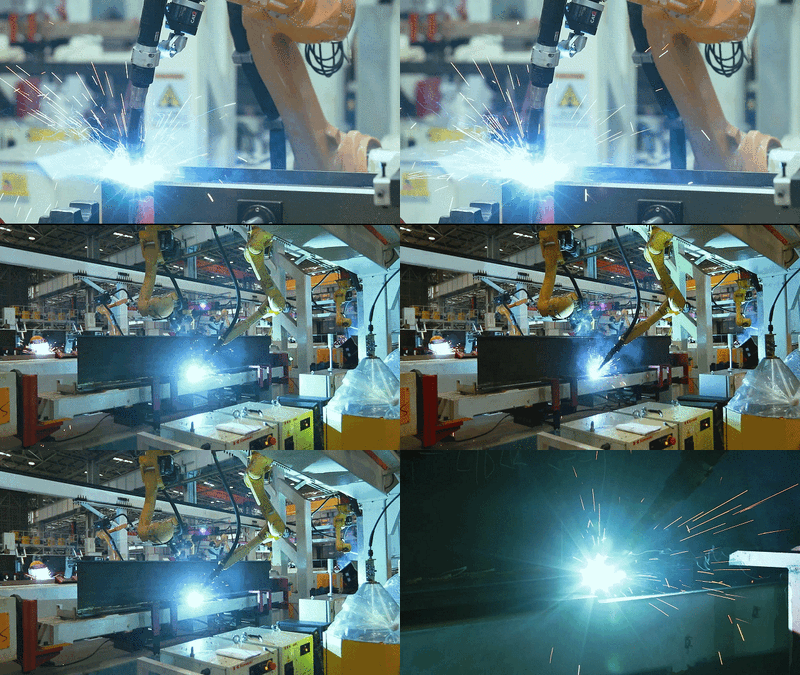
1.穩定和提高焊接質量,保證其均一性。焊接參數如焊接電流、電壓、焊接速度和干伸長量等對焊接結果有著決定作用。采用機器人焊接時,每條焊縫的焊接參數都是恒定的,焊縫質量受人為因素影響較小,降低了對工人操作技術的要求,因此焊接質量穩定。而人工焊接時,焊接速度、干伸長量等都是變化的,很難做到質量的均一性。
Stabilize and improve welding quality to ensure its uniformity. Welding parameters such as welding current, voltage, welding speed, and dry elongation have a decisive effect on the welding results. When using robot welding, the welding parameters of each weld are constant, and the weld quality is less affected by human factors, reducing the requirements for worker operation technology, so the welding quality is stable. During manual welding, the welding speed and dry elongation are variable, making it difficult to achieve quality uniformity.
2.改善了勞動條件。采用機器人焊接,工人只需要裝卸工件,遠離了焊接弧光、炯霧和飛濺等。對于點焊來說,工人無需搬運笨重的手工焊鉗,使工人從高強度的體力勞動中解脫出來。
Improved working conditions. Using robot welding, workers only need to load and unload the workpiece, away from welding arc light, intense fog, and spatter. For spot welding, workers do not need to carry heavy manual welding tongs, freeing them from high intensity manual labor.
3.提高勞動生產率。機器人可24h連續生產。隨著高速高效焊接技術的應用,采用機器人焊接,效率提高得更為明顯。
Improve labor productivity. Robots can be continuously produced for 24 hours. With the application of high-speed and efficient welding technology, the efficiency of robot welding has been significantly improved.
4.產品周期明確,容易控制產品產量。機器人的生產節拍是同定的,因此安排生產計劃非常明確。
Clear product cycle, easy to control product output. The production rhythm of the robot is fixed, so the production plan is very clear.
5.縮短產品改型換代的周期,減小相應的設備投資。可實現小批量產品的焊接自動化。機器人與專機的最大區別就是可以通過修改程序以適應不同工件的生產。
Shorten the cycle of product upgrading and reduce the corresponding equipment investment. It can realize welding automation of small batch products. The biggest difference between robots and specialized machines is that they can adapt their programs to different workpiece production.
在實際焊接過程中的環境和條件的變化是不可避免的,如焊接工件加工和裝配誤差造成接頭位置、焊縫間隙和尺寸的分散性,示教軌跡與實際焊縫的差異、焊接過程中熱變形、熔透及焊縫成形不穩定等因素都會引起焊接質量的波動,并導致焊接缺陷的產生。
Changes in the environment and conditions during the actual welding process are inevitable, such as the dispersion of joint positions, weld gaps, and dimensions caused by welding workpiece processing and assembly errors, the difference between the teaching trajectory and the actual weld, thermal deformation, penetration, and unstable weld formation during the welding process, which can cause fluctuations in welding quality and lead to welding defects.
為了克服焊接過程中各種不確定性因素對精密焊接質量的影響,需要采用信息反饋、智能控制等技術提高現行焊接機器人的適應性或智能化水平,使之能實現初始焊位識別與自主導引、實時焊縫糾偏與跟蹤,焊接熔池動態特征信息獲取、工藝參數自適應調節和焊縫成形的實時控制,即實現機器人焊接過程的自主智能控制,從而彌補焊接機器人在自動焊接方面的不足。
In order to overcome the impact of various uncertain factors on precision welding quality during the welding process, it is necessary to adopt technologies such as information feedback and intelligent control to improve the adaptability or intelligence level of current welding robots, so as to enable them to achieve initial welding position recognition and autonomous guidance, real-time weld deviation correction and tracking, acquisition of dynamic feature information of the welding pool, adaptive adjustment of process parameters, and real-time control of weld formation, That is, to achieve autonomous and intelligent control of the robot welding process, thereby making up for the shortcomings of welding robots in automatic welding.
針對鋁合金在焊接過程中熱積累作用強、恒參數焊接時容易產生各種缺陷的問題,設計了模糊專家控制系統。通過CCD獲得熔池的圖像以及相應的圖像處理軟件計算出熔寬的大小,然后該模糊控制器控制焊接熱輸入,專家系統負責脈沖參數匹配,從而維持熔寬不變,即保證了焊接質量的穩定性,適應于自動化的生產要求。
A fuzzy expert control system is designed to solve the problems of strong heat accumulation in the welding process of aluminum alloys and various defects easily generated during constant parameter welding. The image of the weld pool is obtained through CCD and the corresponding image processing software calculates the size of the weld width. Then, the fuzzy controller controls the welding heat input, and the expert system is responsible for pulse parameter matching to maintain the weld width unchanged, which ensures the stability of the welding quality and is suitable for automated production requirements.
在鋼結構等現場施工中,結構件形狀復雜,除常規的圓形、方形的工件外,還有間斷不連續的、橢圓形的、外形漸變的工件以及厚壁、大型工件,要想最大限度解決現場的自動化焊接,充分發揮焊接機器人的現場施工利用率,提高焊接效率,可選用直導軌、圓導軌、柔性導軌實現各種復雜曲面的全位置焊接,可以適應不規則焊縫的軌跡跟蹤,實現多層多道焊及全位置焊的自動化焊接。
In on-site construction such as steel structures, structural components have complex shapes. In addition to conventional circular and square workpieces, there are also discontinuous, elliptical, and tapered workpieces, as well as thick wall and large workpieces. To maximize the automation of on-site welding, fully utilize the on-site construction utilization of welding robots, and improve welding efficiency, straight rails, circular rails Flexible guide rails realize all position welding of various complex curved surfaces, which can adapt to track tracking of irregular welds, and realize automatic welding of multi-layer multi-pass welding and all position welding.
焊接機器人