

工業機器人的組成結構系統和發展趨勢分析!
發布時間:
2023-02-10 11:24
工業機器人具有一定的自動性,能夠依靠自身的動力能源和控制能力實現各種工業加工制造功能,廣泛用于工業領域的多關節機械手或多自由度的機器裝置。工業機器人被廣泛應用于電子、物流、化工等各個工業領域。
Industrial robots have a certain degree of automaticity. They can realize various industrial processing and manufacturing functions by relying on their own power and control capabilities. They are widely used in the industrial field of multi joint manipulators or multi degree of freedom machine devices. Industrial robots are widely used in electronic, logistics, chemical and other industrial fields.
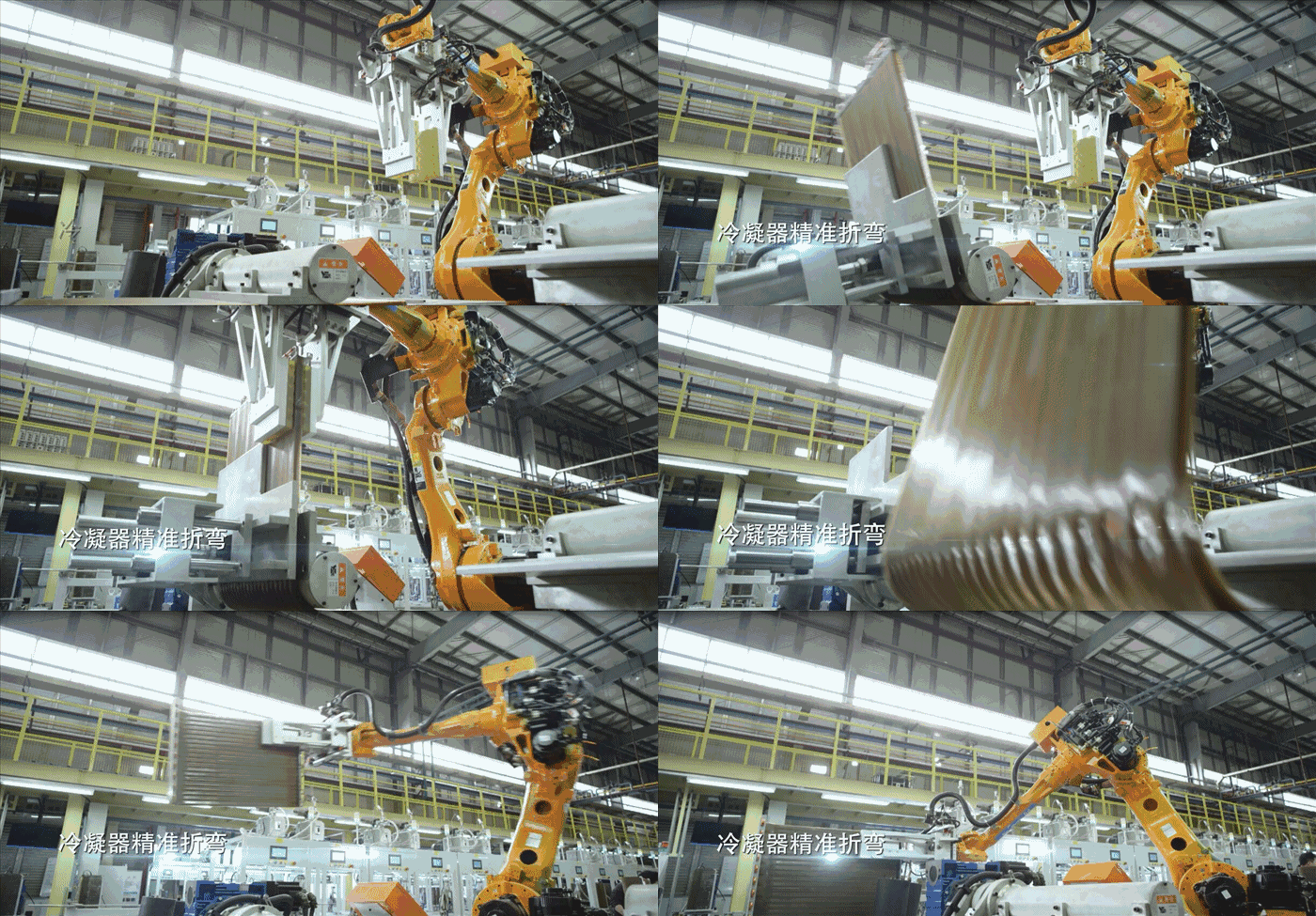
工業機器人的組成
Composition of industrial robots
一般來說,工業機器人由三大部分六個子系統組成。三大部分是機械部分、傳感部分和控制部分;六個子系統可分為機械結構系統、驅動系統、感知系統、機器人-環境交互系統、人機交互系統和控制系統。
Generally speaking, industrial robots are composed of three major parts and six subsystems. The third part is mechanical part, sensing part and control part; The six subsystems can be divided into mechanical structure system, drive system, perception system, robot environment interaction system, human-computer interaction system and control system.
1.機械結構系統
Mechanical structure system
從機械結構來看,工業機器人總體上分為串聯機器人和并聯機器人。串聯機器人的特點是一個軸的運動會改變另一個軸的坐標原點,而并聯機器人一個軸運動則不會改變另一個軸的坐標原點。
In terms of mechanical structure, industrial robots are generally divided into series robots and parallel robots. The characteristic of the serial robot is that the motion of one axis will change the coordinate origin of the other axis, while the motion of one axis of the parallel robot will not change the coordinate origin of the other axis.
2.驅動系統
Drive system
驅動系統是向機械結構系統提供動力的裝置。根據動力源不同,驅動系統的傳動方式分為液壓式、氣壓式、電氣式和機械式4種。早期的工業機器人采用液壓驅動。由于液壓系統存在泄露、噪聲和低速不穩定等問題,并且功率單元笨重和昂貴,目前只有大型重載機器人、并聯加工機器人和一些特殊應用場合使用液壓驅動的工業機器人。
The drive system is a device that provides power to the mechanical structure system. According to different power sources, the drive system can be divided into four types: hydraulic, pneumatic, electrical and mechanical. Early industrial robots were driven by hydraulic pressure. Due to the problems of leakage, noise and low speed instability in the hydraulic system, and the cumbersome and expensive power units, there are only large heavy-duty robots, parallel processing robots and industrial robots driven by hydraulic power in some special applications.
3.感知系統
Perception system
機器人感知系統把機器人各種內部狀態信息和環境信息從信號轉變為機器人自身或者機器人之間能夠理解和應用的數據和信息,除了需要感知與自身工作狀態相關的機械量,如位移、速度和力等,視覺感知技術是工業機器人感知的一個重要方面。視覺伺服系統將視覺信息作為反饋信號,用于控制調整機器人的位置和姿態。
The robot perception system transforms various internal state information and environmental information of the robot from signals to data and information that can be understood and applied by the robot itself or among robots. In addition to sensing the mechanical quantities related to its own working state, such as displacement, speed and force, visual perception technology is an important aspect of industrial robot perception. The visual servo system uses visual information as feedback signals to control and adjust the position and posture of the robot.
4. 機器人-環境交互系統
Robot environment interaction system
機器人-環境交互系統是實現機器人與外部環境中的設備相互聯系和協調的系統。機器人與外部設備集成為一個功能單元,如加工制造單元、焊接單元、裝配單元等。當然也可以是多臺機器人集成為一個去執行復雜任務的功能單元。
The robot environment interaction system is a system that realizes the interconnection and coordination between robots and equipment in the external environment. The robot and external equipment are integrated into a functional unit, such as processing and manufacturing unit, welding unit, assembly unit, etc. Of course, multiple robots can also be integrated into a functional unit to perform complex tasks.
5.人機交互系統
Human computer interaction system
人機交互系統是人與機器人進行聯系和參與機器人控制的裝置。例如:計算機的標準終端、指令控制臺、信息顯示板、危險信號報警器等。
Human computer interaction system is a device for people to connect with robots and participate in robot control. For example: standard terminal of computer, instruction console, information display board, danger signal alarm, etc.
6.控制系統
Control system
控制系統的任務是根據機器人的作業指令以及從傳感器反饋回來的信號,支配機器人的執行機構去完成規定的運動和功能。如果機器人不具備信息反饋特征,則為開環控制系統;具備信息反饋特征,則為閉環控制系統。
The task of the control system is to control the executive mechanism of the robot to complete the specified movement and function according to the robot's work instructions and the signals fed back from the sensors. If the robot does not have the characteristics of information feedback, it is an open loop control system; If it has the characteristics of information feedback, it is a closed loop control system.
工業機器人的發展趨勢
Development Trend of Industrial Robots
1.人機協作
Man machine cooperation
隨著機器人從與人保持距離作業向與人自然交互并協同作業方面發展。拖動示教、人工教學技術的成熟,使得編程更簡單易用,降低了對操作人員的專業要求,熟練技工的工藝經驗更容易傳遞。
With the development of robots from distance operation to natural interaction and collaborative operation with people. The maturity of drag teaching and manual teaching technology makes programming easier to use, reduces the professional requirements for operators, and makes the process experience of skilled technicians easier to transfer.
2.自主化
Autonomy
目前機器人從預編程、示教再現控制、直接控制、遙操作等被操縱作業模式向自主學習、自主作業方向發展。智能化機器人可根據工況或環境需求,自動設定和優化軌跡路徑、自動避開奇異點、進行干涉與碰撞的預判并避障等。
At present, robots have developed from pre programming, teaching and playback control, direct control, teleoperation and other manipulated operation modes to autonomous learning and autonomous operation. The intelligent robot can automatically set and optimize the path, avoid singular points, predict interference and collision, and avoid obstacles according to the working conditions or environmental requirements.
3.智能化、信息化、網絡化
Intelligence, informatization and networking
越來越多的3D視覺、力傳感器會使用到機器人上,機器人將會變得越來越智能化。隨著傳感與識別系統、人工智能等技術進步,機器人從被單向控制向自己存儲、自己應用數據方向發展,逐漸信息化。隨著多機器人協同、控制、通信等技術進步,機器人從獨立個體向相互聯網、協同合作方向發展。
More and more 3D vision and force sensors will be used on robots, and robots will become more and more intelligent. With the progress of sensing and recognition systems, artificial intelligence and other technologies, robots have developed from one-way control to self storage and self application of data, and gradually become information-based. With the technological progress of multi robot cooperation, control, communication and other technologies, robots have developed from independent individuals to the direction of Internet and collaborative cooperation.
工業機器人